Journey Map
A pain that looks small on its own is often sitting right on the step that decides everything. You only see that when you map the whole path instead of staring at one moment.
A journey map lays the whole path out so the breaking step can't hide in the noise of the loud one.
You met this artifact already, back in Synthesis, as one of three ways to package what you heard so it survives contact with your team. Back there you learned what a journey map is and why it earns its place. Here you build one. This page is the recipe.
What it is
A journey map lays out, step by step, what a customer goes through to get one job done, start to finish, with the highs and lows marked along the way.
It's a timeline, not a snapshot. A persona is a stand-in character built from a pattern across many people, so a team can aim at one consistent face. An empathy map freezes one person at one moment. A journey map does the opposite of freezing. It walks the entire path: what they do first, what they do next, where they hit the wall, where they give up or break through.
It's worth the effort because it shows you problems in context. A complaint that sounds minor in the interview turns out to land at the exact step everything else depends on. You'd never have caught that looking at the moment alone.
The journey map comes out of the design-thinking tradition, the same lineage that gave us most of these tools: the Stanford design school (the d.school) and the design firm IDEO. The Nielsen Norman Group has the cleanest write-up of the structure if you want to go deeper. I teach it in the design thinking course I run at the University of Illinois, at the Siebel Center for Design, alongside the persona and the empathy map.
The template
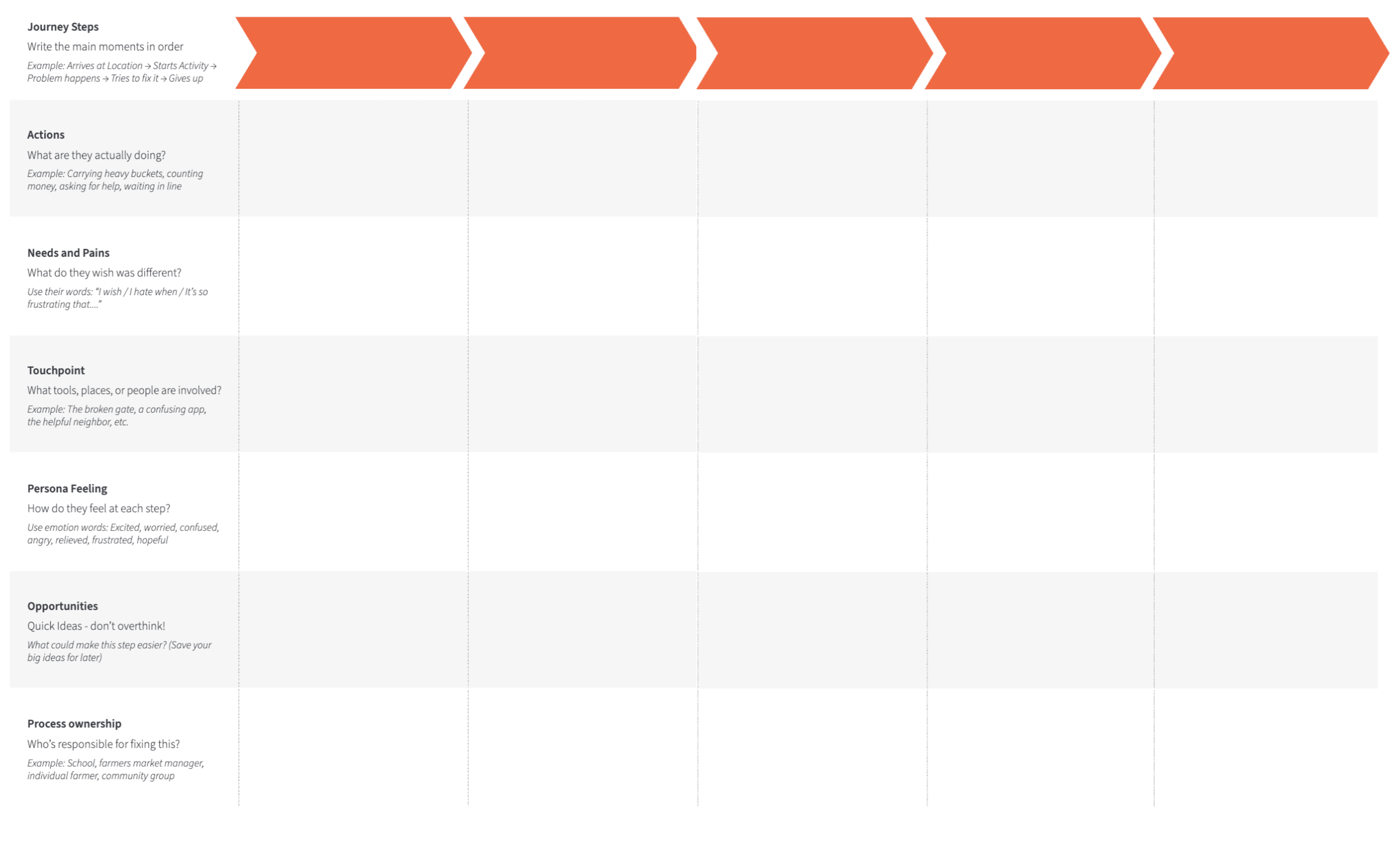
A blank journey map is a grid. The columns are the steps of the journey, left to right, in the order they happen. The rows are the same set of questions you ask at every step. You fill the grid straight from your research. No inventing a path you didn't watch someone walk.
-
Stages. The big phases of the journey, across the top. Three to six of them, named for what the person is trying to do, not for your internal process. "Realizes they have a problem," "looks for a fix," "tries the first option," "gives up or commits." These are the columns everything else hangs under.
-
Steps / actions. Inside each stage, the concrete things the person actually does, in order. The clicks, the calls, the spreadsheet they open, the person they text. Real behavior you observed or they described, not the idealized flow from your product spec.
-
Thoughts. What's going through their head at that step. The question they're asking, the thing they're unsure about, what they expect to happen next.
-
Emotions. How they feel at each step, and this is the row that tells you where the opportunity is. Plot it as a line that rises and falls across the stages, high where it's working, low where it hurts. The dips are the whole point. The lowest point on that line is usually where your opportunity is, because that's where it hurts most, so a fix there is worth the most.
-
Pain points. The specific friction at each step. Where they get stuck, confused, frustrated, or quit. Call them out plainly and tie each one to its step, so the pain has an address instead of floating loose.
-
Opportunities. What you could do at each step to ease the pain or raise the line. You fill this last, after the rest of the map shows you where it hurts. This is the row that turns a diagram into a to-do list.
Two rules while you build it. Pick one specific person doing one specific job, not "users in general" doing "stuff." A map that tries to cover everyone covers no one. And every row traces back to real research. If you can't point to the interview under a step, you're not mapping a journey, you're drawing your own assumptions in a nicer grid.
A worked example
Say you're building a tool for people job-hunting, and you've mapped the journey of Dana, the over-applied job seeker from the persona, start to finish. Here's the shape of her map, stage by stage.
- Sees a posting (high). Finds a role that fits on paper. Thinks "this one's me." Feels hopeful. The line starts up.
- Applies (slight dip). Re-tailors the resume, fills the same fields a fourth time, hits submit. Feels the start of fatigue. Pain point: every application is manual, from scratch.
- Waits (deep dip). Days pass. Nothing. Refreshes her email. Thinks "did it even go through?" Feels anxious. Pain point: total silence, no signal she's still in it.
- Gets the auto-rejection, or nothing (lowest point). A form email, or no reply at all. Thinks "I'm starting to think the problem is me." Feels defeated. Pain point: a rejection with no reason teaches her nothing.
- Tries again (flat, drained). Opens the job board and applies to five more, faster and with less care. Thinks "volume is the strategy." Feels numb. Pain point: the despair pushes her toward exactly the behavior that isn't working.
Now look at the line. The dip isn't the application. It's the wait and the silent rejection, the stretch in the middle where she gets no signal at all. If you only looked at the moment she applies, you'd build a faster application form. The journey tells you the real wound is downstream, in the silence. So you don't build a better submit button. You build something that breaks the silence and tells her where she actually stands.
That's a journey map doing its job. It moved the fix from the loud step to the step that actually decides whether she keeps going.
When to reach for it, and when not
Reach for a journey map when the problem is a sequence, and you need to find where in the flow it breaks.
That's the signal. The trouble isn't a single moment and it isn't a fuzzy "who," it's an order of events, a hand-off, a drop-off. People keep falling out somewhere between starting and finishing and you can't yet say where. The journey map is built to find that step. It's also the right tool when a pain feels small in isolation and you suspect it's only small because you're seeing it out of context.
Reach for the sibling artifacts when the shape of the insight is different:
- The team keeps building for a vague "the user" and you need one consistent face to aim at across many decisions. That's a persona. A journey map is a path, not a person. It tells you where, not who.
- The gap is between what someone says and what they do, and that gap is the point. That's an empathy map. A journey map walks the timeline; it won't hold one contradiction up at one moment the way an empathy map does.
- You haven't done the research yet. Then you have no real path to map, and a journey drawn from your own head is just your product plan wearing a customer's name. Go run the conversations first. The Interview Guide gets you the raw material, and Talking to Customers is the mindset behind it.
You don't build all three artifacts on every project. You build the one that makes your insight undeniable to the people who have to act on it. When the insight is that something breaks at a specific step in a longer flow, the journey map is the one that puts your finger on the step.