Empathy Map
People will tell you one thing and do another. Not because they're lying. Because the gap between what we say and what we do is mostly invisible to us.
An empathy map is the tool that catches that gap and holds it up where you can't look away from it.
You met this artifact already, back in Synthesis, as one of three ways to package what you heard so it survives contact with your team. The other two are the persona and the journey map, both linked below. That page tells you what an empathy map is and why it earns its place. This page is the recipe. How to actually build one.
What it is
An empathy map captures what one customer says, thinks, does, and feels about one situation. One person. One moment. Four quadrants.
That's it. It's not a persona, and it's not a journey map. A persona is a stand-in character built from a pattern across many people. A journey map is a timeline of a whole task, start to finish. An empathy map zooms all the way in: one human, frozen at one moment, seen from four angles at once.
The whole point is the gap between the angles. What someone says and what they actually do are often two different things, and that gap is where the real insight hides. The map exists to make that gap impossible to miss.
The four-quadrant version comes out of the design-thinking tradition, the same Stanford d.school and IDEO lineage that gave us most of these tools, and the Nielsen Norman Group has the cleanest write-up of the structure if you want to go deeper. I teach it in the design thinking course I run at the University of Illinois, at the Siebel Center for Design, and I use it on real product work for the same reason. It forces you to separate what a person performs from what they actually carry, the real worry or struggle sitting underneath the performance.
The template
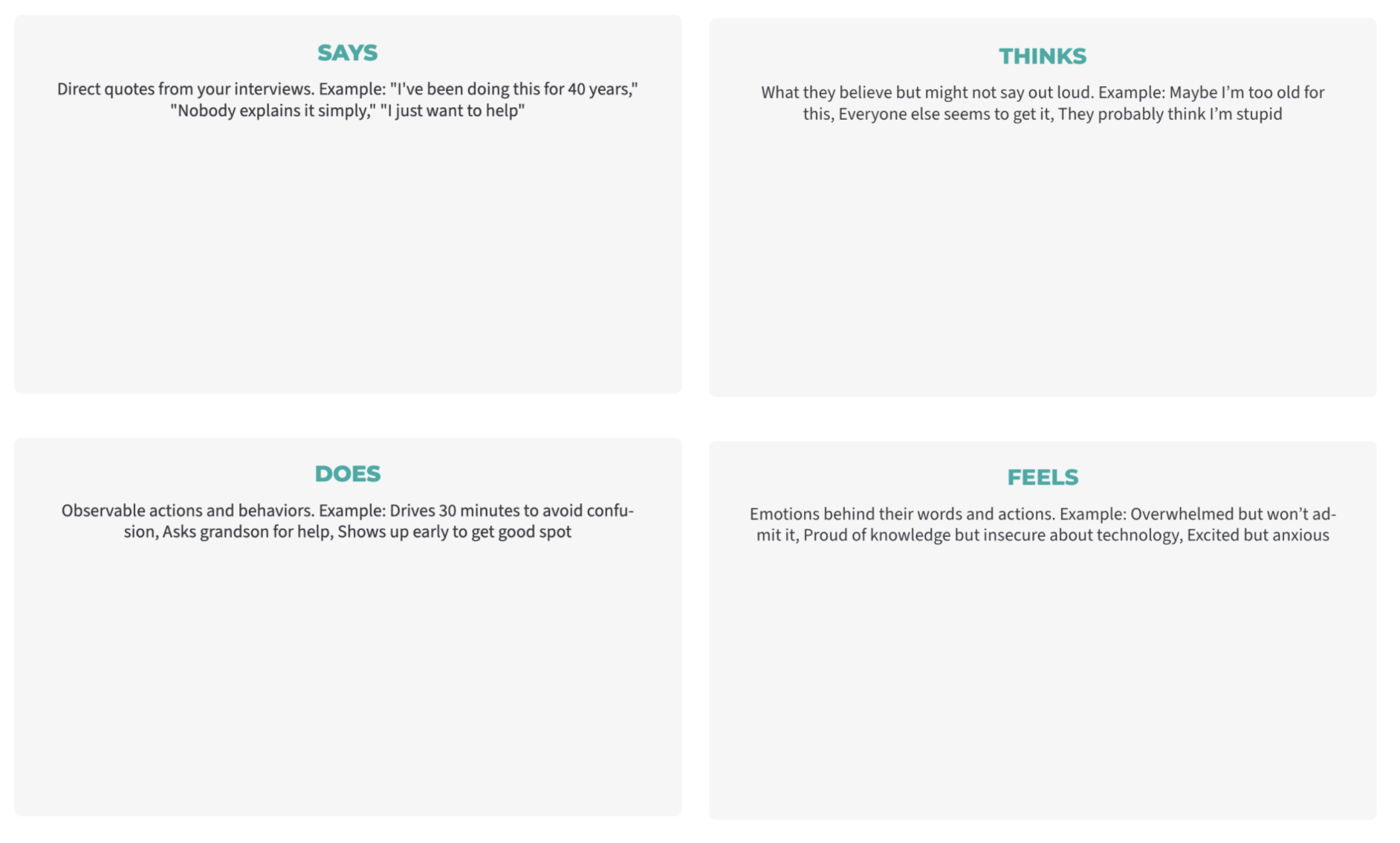
A blank empathy map is a box split into four quadrants, with the customer's name in the middle. You fill each quadrant straight from your interview notes. No inventing. Every entry should trace back to something a real person actually said or did.
-
Says. Their literal words. Direct quotes, as close to verbatim as you have them. "I check the dashboard every morning." Don't clean it up, don't summarize it, use their language. The exact words are the evidence.
-
Thinks. What's going through their head that they didn't say out loud. What they believe, what they're worried about, what they're not telling you. This is inference, so be honest that it's inference, and pull it from the long pause, the hedge, the thing they circled back to twice.
-
Does. Their actual behavior. What you watched them do, or what they described doing. The workaround. The tab they keep open. The spreadsheet they built because the tool didn't do the thing. Actions, not intentions.
-
Feels. Their emotional state in that moment. Frustrated. Anxious. Relieved. Embarrassed. Name the emotion plainly. The body language and the tone tell you more here than the words do.
Two more boxes show up in the common version, sitting along the bottom under the four quadrants. They don't add a new kind of content. They pull the four together into what matters: Pains (the frustrations and obstacles in their way, like "fires off another application and hears nothing back") and Gains (what they're actually trying to get done, the win they're after, like "lands a role that values her real experience and stops feeling invisible"). Those two turn the map from a portrait into something you can act on.
You fill it for one person at a time. If you talked to ten people, you might build a map for the two or three who best represent the patterns you found, not one mushed-together map of everyone. Blend ten people into one map and it stops being a real person at a real moment, which is the one thing the tool is for. Averaging across people is exactly what a persona does on purpose. Do it here by accident and you've built a vague persona without the deliberate craft that makes a persona useful.
A worked example
Say you're building a tool for people stuck deep in a long job search, and you sat down with Dana, three months in and running low. Her map might look like this.
- Says: "I've sent out two hundred applications and heard back from four." / "I just have to keep at it."
- Thinks: That the problem might be her. That messaging people in her network for help would be admitting she's failing. That everyone else seems to have this figured out.
- Does: Lives on the job boards and applies to everything, fast. Refreshes her email for replies that never come. Has barely reached out to a single person in her own network.
- Feels: Defeated. Anxious in the silence. Embarrassed at the thought of asking anyone for help.
Look at the gap. She says she just has to keep at it, apply to more, grind harder. What she does, firing résumés into silence while leaving her own network untouched, and what she feels, too embarrassed to ask, tell the truth she didn't say out loud. The wound isn't that she hasn't applied enough. It's the silence, and the shame that keeps her from the one move that actually works.
If you only had the Says quadrant, you'd build her a faster way to apply to even more jobs. The Does and Feels quadrants tell you the truth. More volume is the trap she's already in. So you're not building a better application blaster. You're building something that breaks the silence and makes reaching out to a real person feel safe instead of like a confession.
That's an empathy map doing its job. Four sentences from one interview, and now you know you're not building more volume, you're building a way out of the silence.
When to reach for it
Reach for an empathy map when someone's words and actions don't line up, and that gap is the point.
That's the specific signal. You walk out of an interview with a nagging feeling that what the person told you and what they're actually doing don't match. The empathy map is built to catch exactly that. It's also the right tool when you need to build genuine understanding of one customer before you design anything, or when your team is arguing about a "user" nobody can actually picture.
Reach for the other artifacts when the job is different:
- The problem is a sequence, where in the flow does it break, who hands off to whom, where do they give up. That's a journey map. An empathy map is a snapshot, not a timeline. It won't show you order.
- The team keeps building for a vague "everyone" and you need one consistent face to aim at across many decisions. That's a persona. An empathy map is one real person at one moment, not a durable stand-in.
- You haven't done the interviews yet. Then you have nothing to put in the quadrants, and you'd be inventing a customer instead of mapping one. Go run the conversations first. The Interview Guide is how you get the raw material, and Talking to Customers is the mindset behind it.
Don't build all three on every project. You build the one that makes your insight undeniable to the people who have to act on it. When the insight is that split between word and action, the empathy map is the one that makes it stick.