Apple Marketing Philosophy
This one sits at the end of the leadership section on purpose. It's short, it isn't mine, and it quietly ties the whole section together.
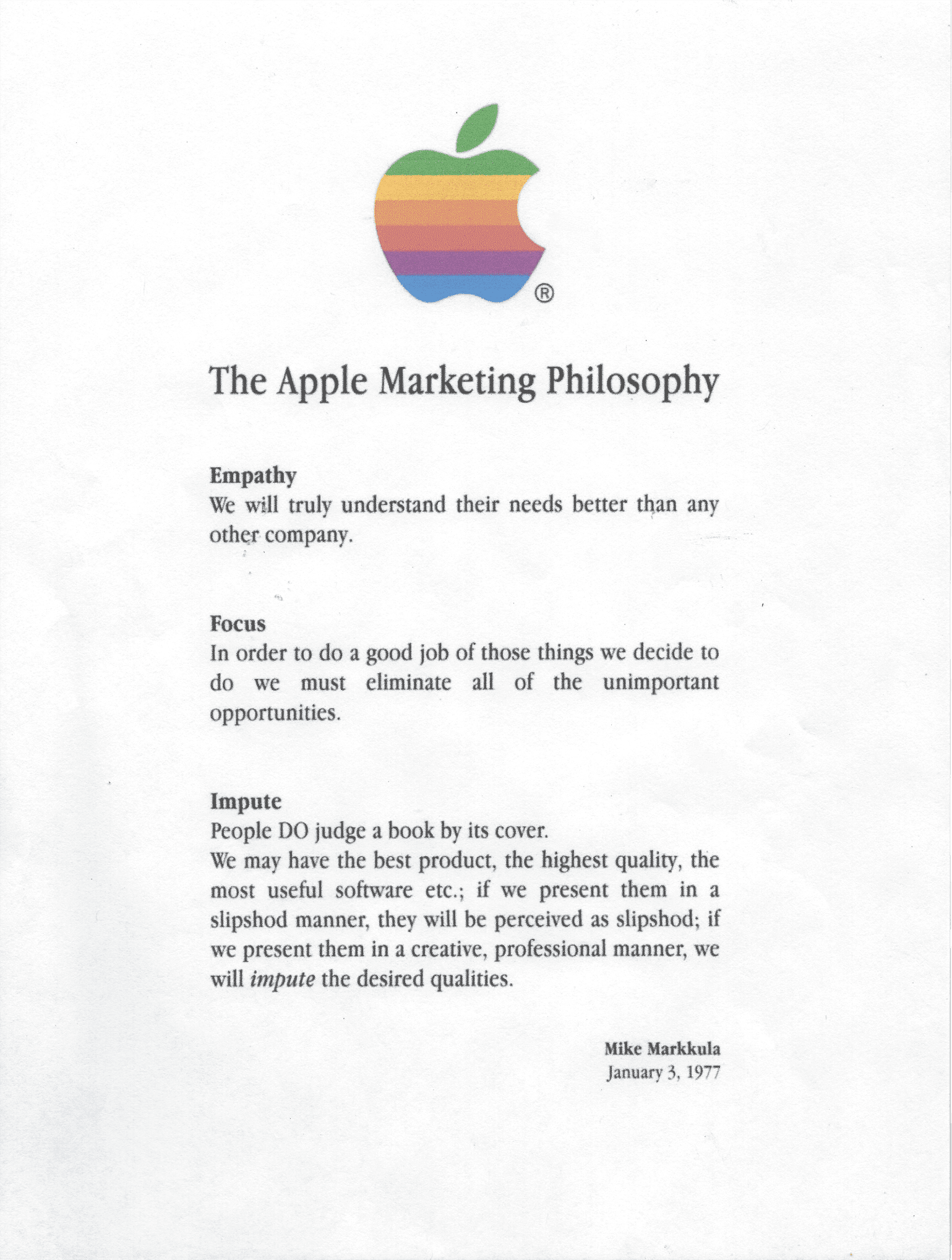
In 1977, Mike Markkula wrote a one-page marketing philosophy for a young Apple. Three words. It has held up for almost fifty years, and it says more about how to build and sell product than most modern frameworks. You've already read all three. You just didn't see them named yet.
Empathy
If we have empathy for our customers and dealers, we will truly understand their needs better than any other company.
Read it as a standard, not a sentiment. Not "we'll understand our customers." Better than any other company. That's a low bar.
It's the same instinct behind getting close to the customer, behind discovery, behind the whole opportunity backlog. Each one is empathy aimed at the person who'll use the thing you build.
As we discussed earlier, the essence of the work you do is solving problems for other people, and the only way to do that is to understand their emotions, what drives them, their hopes and their dreams. Anything less is guessing.
Focus
In order to do a good job of those things that we decide to do, we must eliminate all of the unimportant opportunities.
Focus is saying no. It's the discipline behind cutting a bloated backlog, refusing a roadmap of unvalidated bets, pointing a team at the few problems that matter.
I learned this the expensive way. I once spread a team of interns across too many projects for eight months to look innovative. Had I pointed them at two or 3 projects that really mattered, we'd have driven millions in revenue increase or cost savings. Instead we saved a few thousand and felt busy.
Most organizations fail here not because they pick the wrong things, but because they refuse to stop doing the other things.
Impute
People DO judge a book by its cover. We may have the best product, the highest quality, the most useful software; if we present them in a slipshod manner, they will be perceived as slipshod; if we present them in a creative, professional manner, we will impute the desired qualities.
How you present the work shapes how it's perceived. True of products, true of you and your ideas.
I was sixteen, umpiring a 12-year-old travel baseball game. It was the bottom of the last inning and a runner was thrown out at second in a very close play. I made the call in a barely audible voice, like it was the second inning and nothing was riding on it. Coaches, parents, players, all of them turned on me instantly. Why? Because it didn't look like I believed my own call. The call was right. The cover was wrong, and the cover is what the crowd bought.
Presentation matters, regardless of your certainty on the topic. It's why how you talk to executives matters, why how you sell an idea is as important as the idea, why a sloppy rollout sinks a good solution. Substance has to be there first. But people read the cover, so make the cover honor it.
Who all of this is for
Empathy, focus, impute. Understand them better than anyone, do fewer things well, present it all to match the quality inside. Every page in this section has been one of these three in disguise.
The one running underneath all of it is empathy. Not as a feeling. As the customer obsession this whole section has been circling. Everything else is how you serve the person on the other end of the work.